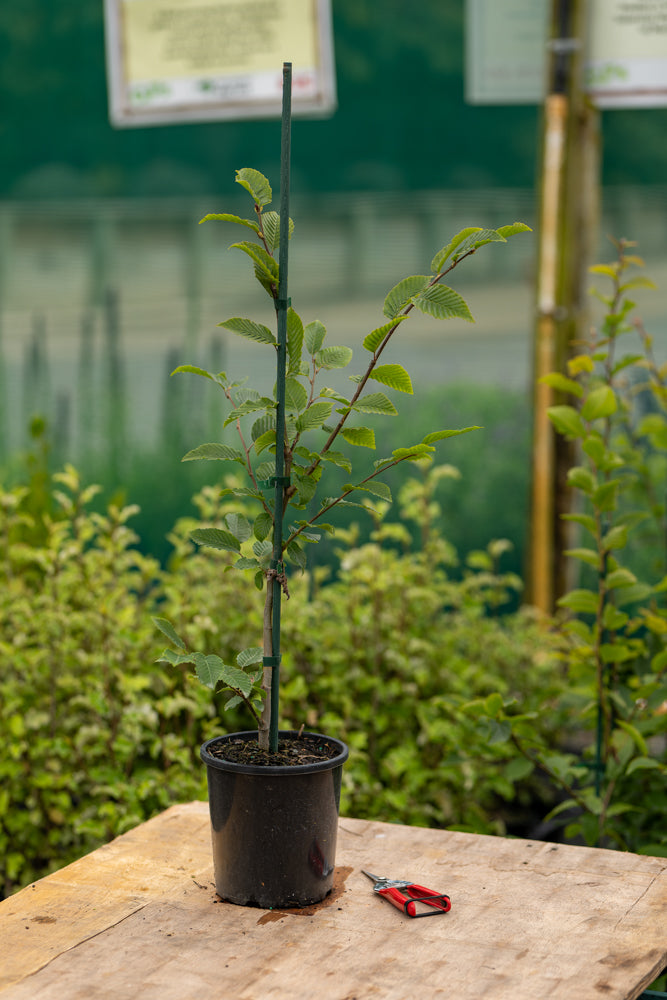
Carpinus Betulus
Carpinus Betulus
European Hornbeam, Common Hornbeam
Carpinus betulus, commonly known as European Hornbeam or Common Hornbeam, is a hardy deciduous tree valued for its dense foliage, attractive branching and ability to handle regular pruning. Left to grow naturally, it develops into a substantial, broadly rounded shade tree. Get the hedge trimmer involved, however, and Hornbeam can be maintained as an excellent formal hedge or screen.
Fresh green, deeply veined leaves emerge in spring and create dense cover through summer before turning yellow to golden-brown in autumn. One of Hornbeam's particularly useful characteristics is that young plants and regularly clipped hedges can retain some of their dried brown leaves through winter, providing more screening than many completely bare deciduous hedges.
It's hardy, frost tolerant and adaptable – a very practical option for New Zealand gardens and larger landscapes where you need a plant to do an actual job as well as look good.
Why You'll Love Carpinus betulus
- Excellent deciduous hedging and screening tree
- Responds extremely well to clipping
- Can also be grown as a large feature or shade tree
- Dense fresh green summer foliage
- Attractive golden-yellow autumn colour
- Clipped hedges may retain brown foliage into winter
- Extremely frost hardy
- Tolerates a range of soil conditions
- Excellent for formal and traditional landscapes
- Long-lived and relatively low maintenance
- Expected 5 Year Height 8.0 M Width 6.0 M
Is Carpinus Betulus suitable for my garden?
Is Carpinus Betulus suitable for my garden?
Carpinus Betulus is best suited in a position that gets
- Partial shade
- Full sun
Carpinus Betulus is
- Wind Tolerant
- Frost Tolerant
- Cold hardy
- Fast-growing
- Deciduous
Carpinus Betulus will thrive in soil that is
- Clay
- Normal
- Acidic
- Nutrient rich
- Free draining
- Sandy
How to establish your Carpinus Betulus?
How to establish your Carpinus Betulus?
Plant Carpinus betulus in full sun to part shade.
It is adaptable, but for the densest growth and strongest autumn colour, a position with good sunlight is preferable.
When planting as a full-sized tree, allow plenty of room for its eventual canopy.
When using it as a hedge, consider the mature width you intend to maintain and leave enough room to access both sides for trimming.
How to maintain your Carpinus Betulus once established?
How to maintain your Carpinus Betulus once established?
Water deeply and regularly during the first couple of growing seasons.
This is particularly important for hedging, where multiple plants are competing for available moisture.
Once established, Hornbeam has reasonable tolerance to dry periods, although supplementary watering during prolonged Canterbury drought will keep plants growing strongly.
A hedge that is regularly clipped will generally benefit from more consistent moisture than a mature standalone tree.
Apply organic mulch around newly planted trees or along the base of a new hedge.
Mulching helps:
Retain soil moisture
Suppress competing weeds and grass
Moderate soil temperature
Improve soil structure over time
Keep mulch away from direct contact with the trunks.
Pruning and Hedge Maintenance
Establishing a Hornbeam Hedge
During the first few years, concentrate on creating dense growth from the bottom upwards.
Lightly prune side growth to encourage branching rather than allowing all the energy to head straight for the sky.
For a traditional hedge, keep the base slightly wider than the top. This allows light to reach the lower branches and helps prevent the bottom becoming thin and bare.
Once your hedge reaches the desired height:
Trim to maintain the required shape.
Remove excessively vigorous shoots.
Keep the base slightly broader than the top.
Remove damaged or diseased branches as required.
Hornbeam responds very well to regular clipping and can be maintained as anything from a moderately informal screen to a very crisp formal hedge.
If growing as a standalone tree, much less pruning is required.
Prune young trees to establish a strong framework, removing:
Crossing branches
Damaged growth
Poorly positioned branches
Competing leaders where necessary
Once established, allow the natural canopy to develop.
Carpinus betulus is extremely frost hardy, making it an excellent choice for cooler New Zealand regions.
Established plants require very little winter protection.
The dried foliage retained on clipped plants can also provide attractive copper-brown colour and structure through winter before fresh green growth appears in spring.
Couldn't load pickup availability
Share