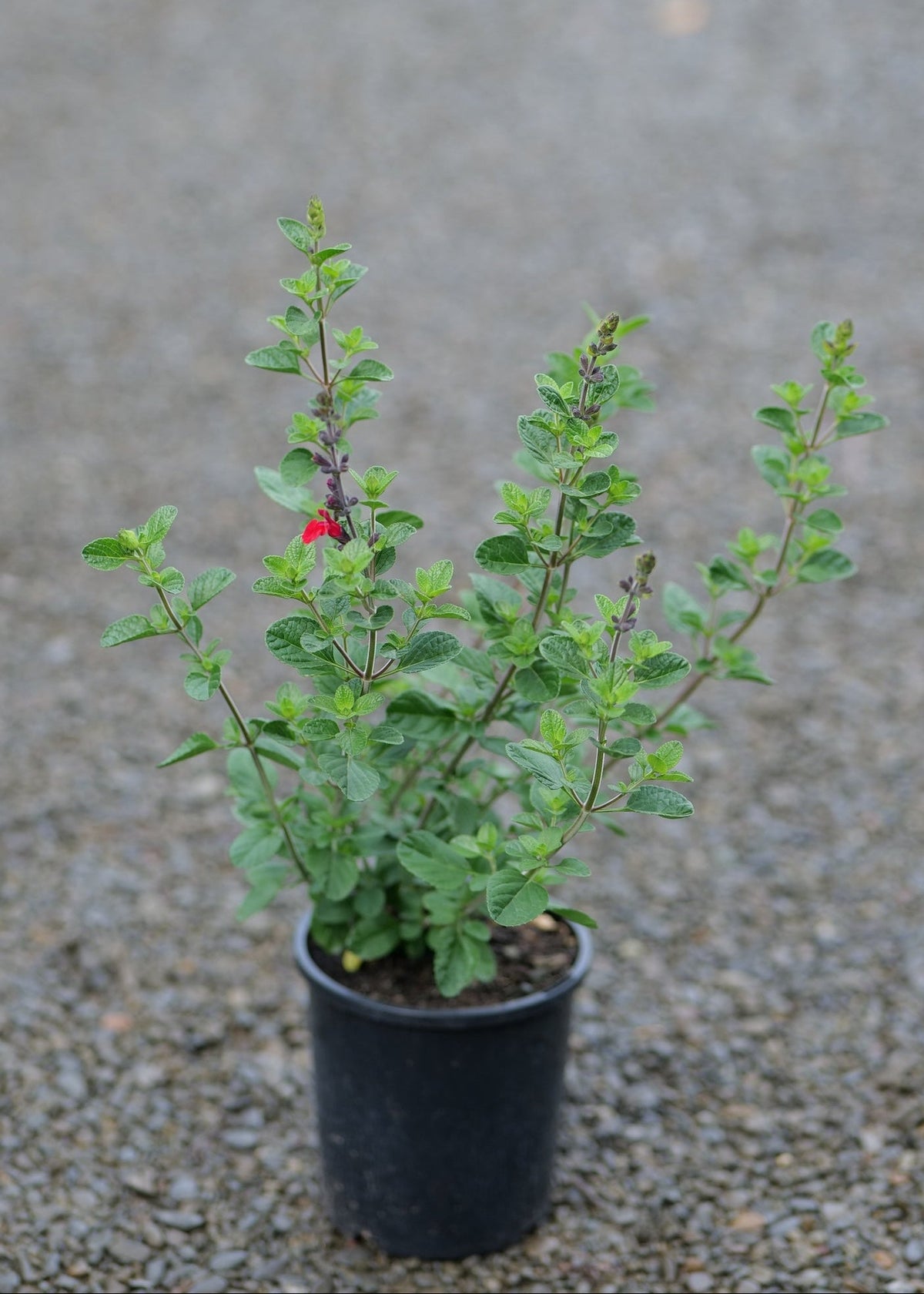
Salvia 'Riverton Red'
Salvia 'Riverton Red'
Salvia 'Riverton Red' (Salvia × jamensis 'Riverton Red') is a beautiful, compact shrubby perennial producing masses of rich, velvety purple-red flowers from late spring through summer and into autumn.
The small, two-lipped flowers are carried on slender upright stems above aromatic, dark green foliage, creating a colourful display that keeps going long after many other perennials have finished flowering.
Selected and named at Marshwood Gardens in Invercargill, Riverton Red is a lovely example of a garden-worthy salvia with a New Zealand connection.
Growing to approximately 60–75cm high and 60–75cm wide, it forms a naturally bushy shrub that's perfect for sunny garden borders, cottage gardens, mass planting, containers and pollinator-friendly gardens.
And if you're looking for a plant that flowers for months without demanding constant attention, this one's worth making room for.
Why You'll Love Salvia 'Riverton Red'
-
Beautiful velvety purple-red flowers
-
Long flowering season from late spring into autumn
-
Attractive aromatic green foliage
-
Compact, bushy growth habit
-
Excellent for sunny perennial borders
-
Attracts bees and other pollinators
-
Good tolerance of dry conditions once established
-
Easy to maintain with seasonal pruning
-
Ideal for cottage-style gardens
-
Great for mass planting
-
Suitable for containers
-
Selected and named in New Zealand
- Expected 5 Year Height 0.25 M Width 0.2 M
Is Salvia 'Riverton Red' suitable for my garden?
Is Salvia 'Riverton Red' suitable for my garden?
Salvia 'Riverton Red' is best suited in a position that gets
- Full sun
- Partial shade
Salvia 'Riverton Red' is
- Perennial
- Drought resistant
- Flowering
- Attracts pollinators
- Fast-growing
Salvia 'Riverton Red' will thrive in soil that is
- Nutrient rich
- Free draining
How to establish your Salvia 'Riverton Red'?
How to establish your Salvia 'Riverton Red'?
Plant Salvia 'Riverton Red' in full sun.
For the best flowering and strongest growth, choose a position receiving at least six hours of direct sunlight daily.
A sunny, open position encourages:
More flowers
Compact, bushy growth
Stronger stems
Healthier foliage
Some light shade may be tolerated, but flowering is generally reduced in heavily shaded positions.
For Canterbury gardens, a sunny border with reasonable protection from severe nor'west winds is ideal.
How to maintain your Salvia 'Riverton Red' once established?
How to maintain your Salvia 'Riverton Red' once established?
Newly planted Salvias: Water regularly during the first growing season to encourage strong root development.
Deep watering is preferable to frequent light watering.
Established Salvias: Once established, Riverton Red develops good tolerance of short dry periods.
However, it will flower more consistently when given additional water during prolonged summer drought.
During Canterbury's hot nor'west conditions, check soil moisture and water deeply when required.
Drought tolerant doesn't mean a plant will appreciate being completely forgotten for three months.
Apply a light layer of organic mulch around the root zone to:
Retain soil moisture
Suppress weeds
Moderate soil temperature
Reduce competition
Help newly planted shrubs establish
Keep mulch away from the crown and main stems.
In heavy soils, avoid excessive moisture-retentive mulch around the base during winter.
Riverton Red generally doesn't require heavy feeding.
Apply a balanced slow-release fertiliser in spring if necessary.
Plants growing in poor soil may benefit from a light application of compost.
Avoid excessive nitrogen fertiliser, which can encourage soft, leafy growth at the expense of flowering.
Container-grown plants may benefit from occasional liquid feeding during the growing season.
Removing spent flower stems can encourage fresh growth and further flowering.
During summer, trim back finished flower spikes to a healthy pair of leaves or developing side shoots.
This helps:
Encourage repeat flowering
Maintain a tidy appearance
Prevent the plant becoming too leggy
Promote fresh branching
You don't need to remove every individual flower.
A light trim when a flowering flush finishes is generally sufficient.
The best time for the main annual prune is early spring, once the risk of severe frost has passed and new growth is beginning.
Trim back the previous season's growth to maintain a compact, bushy shape.
For established plants, this may involve reducing the leafy framework by approximately one-third to one-half, depending on its condition.
Avoid cutting unnecessarily into completely bare, old woody stems.
During summer, occasional light trimming will encourage branching and help maintain a dense plant.
Why Wait Until Spring to Prune?
In colder Canterbury gardens, leaving some of the previous season's growth through winter can help protect the plant's lower stems and crown.
Pruning too early may encourage soft new growth that can be damaged by subsequent frosts.
Wait until spring temperatures begin to improve before carrying out major shaping.
A little patience with the secateurs can save a lot of disappointment.
Salvia 'Riverton Red' is a hardy shrubby salvia, but its foliage and young shoots can be damaged by severe frost.
In colder Canterbury gardens:
Plant in a sunny, sheltered position.
Ensure excellent winter drainage.
Avoid heavy pruning in autumn.
Protect young plants during severe frosts.
Wait until spring before removing frost-damaged growth.
Established plants may lose some foliage during winter before producing fresh growth in spring.
Riverton Red enjoys sunshine and warmth, but prolonged hot, dry nor'west winds can stress plants, particularly during establishment.
During extended dry periods:
Water deeply when required.
Maintain a light mulch layer.
Avoid planting in extremely exposed positions.
Check container-grown plants regularly.
Established plants are reasonably resilient, but consistent moisture will help maintain better flowering during summer.
Riverton Red is generally a relatively trouble-free plant.
Occasional problems may include:
Aphids on tender growth
Whitefly
Spider mites during hot, dry weather
Powdery mildew where airflow is poor
Root rot in poorly drained soil
Good airflow, adequate sunlight and avoiding excessive watering will help prevent many common problems.
Remove badly affected growth and monitor plants for pests during the growing season.
Growing Riverton Red in Containers
Its compact growth habit makes Riverton Red an excellent choice for pots and containers.
It's particularly effective in:
Sunny courtyards
Patio pots
Entrance planting
Cottage-style container displays
Mixed perennial planters
Use a quality free-draining potting mix and ensure the container has adequate drainage holes.
Water regularly during warm weather, as container-grown plants dry out more quickly than those growing in the ground.
Light trimming after flowering will help keep the plant compact and encourage another flush of flowers.
Salvia 'Riverton Red' looks particularly impressive planted in groups.
For a relatively continuous display, space plants approximately 50–60cm apart.
For a more relaxed mixed border, allow around 60–75cm between plants.
Planting in groups of three, five or more creates a stronger visual impact than scattering individual plants throughout the garden.
Its rich red flowers look particularly good when repeated through a border alongside ornamental grasses and softer flowering perennials.
Couldn't load pickup availability
Share