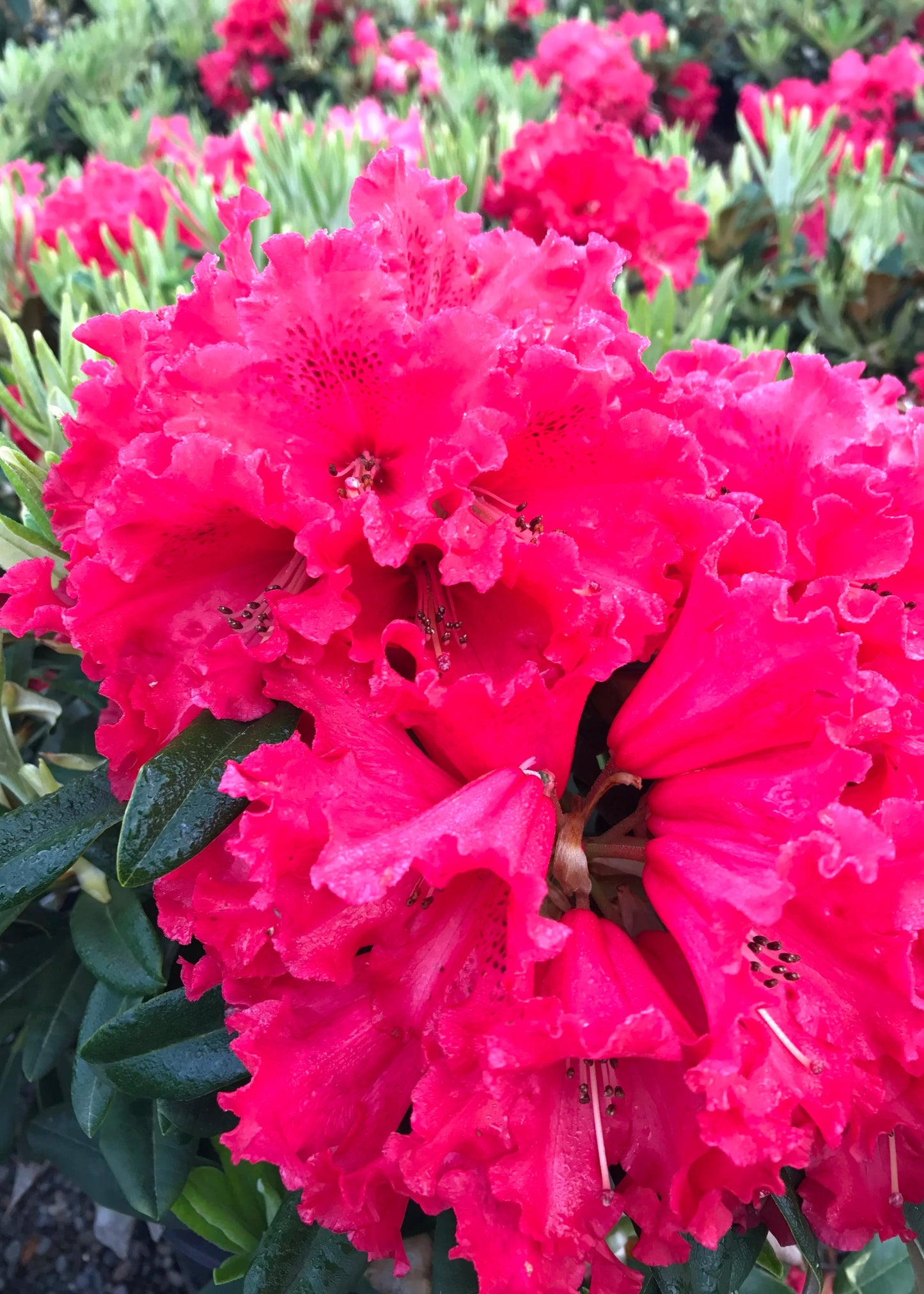
Rhododendron Huntington
Rhododendron Huntington
Rhododendron 'Huntington' is a compact evergreen Rhododendron producing striking trusses of rich red, heavily frilled flowers in spring. If you're after a red Rhododendron but want something a little more interesting than the standard flower shape, Huntington's ruffled blooms definitely earn it a second look.
It forms a naturally dense, low and rounded shrub, with smaller evergreen leaves providing tidy structure throughout the year. Its compact growth makes it particularly useful for smaller gardens, mixed borders, woodland planting and areas where a larger Rhododendron would simply become too much plant.
Hardy and relatively easy to maintain once established, Huntington is a very useful little Rhodo for Canterbury gardens – plenty of flower, plenty of foliage, without eventually attempting to occupy the entire garden bed.
Why You'll Love Rhododendron 'Huntington'
- Rich dark red to bright red flowers
- Distinctive heavily frilled petals
- Compact, naturally rounded growth
- Small, attractive evergreen foliage
- Excellent spring flowering display
- Hardy and frost tolerant
- Great for smaller residential gardens
- Provides year-round evergreen structure
- Requires relatively little pruning
- Excellent in Rhododendron and woodland-style gardens
- Expected 5 Year Height 1.0 M Width 1.0 M
Is Rhododendron Huntington suitable for my garden?
Is Rhododendron Huntington suitable for my garden?
Rhododendron Huntington is best suited in a position that gets
- Partial shade
Rhododendron Huntington is
- Flowering
- Evergreen
- Cold hardy
- Frost Tolerant
Rhododendron Huntington will thrive in soil that is
How to establish your Rhododendron Huntington?
How to establish your Rhododendron Huntington?
Plant Rhododendron 'Huntington' in part shade or filtered sunlight.
Morning sun followed by protection from the strongest afternoon heat is an excellent option.
For Canterbury gardens, aim for:
Morning or filtered sunlight
Protection from hot afternoon sun
Shelter from drying nor'west winds
Consistent soil moisture
Cool roots
Good drainage
Huntington can cope with a reasonable amount of light when moisture is adequate, but a sheltered position will generally keep the foliage looking better through Canterbury's hotter summer weather.
How to maintain your Rhododendron Huntington once established?
How to maintain your Rhododendron Huntington once established?
Water deeply and regularly during the first couple of growing seasons while the plant establishes.
Rhododendrons have relatively shallow root systems, which means the upper soil can dry out faster than you might expect.
Once established, water during prolonged dry periods, particularly during summer.
In Canterbury, keep an eye on soil moisture during periods of hot nor'west wind. These conditions can dry both the foliage and root zone remarkably quickly.
Aim for consistent moisture rather than allowing the soil to repeatedly swing between bone dry and saturated.
Rhododendrons love a good layer of organic mulch.
Apply mulch around the root zone each year to:
Retain soil moisture
Keep roots cool
Reduce weed competition
Add organic matter
Protect the shallow root system
Composted bark and similar organic materials work well.
Keep heavy mulch slightly away from the main stems.
Feed in spring with a fertiliser specifically formulated for Rhododendrons, Azaleas, Camellias or other acid-loving plants.
Follow the recommended application rate rather than assuming twice the fertiliser will give you twice the flowers.
It won't.
Overfeeding can encourage excessive soft growth and potentially damage the shallow root system.
One of Huntington's advantages is its naturally compact habit, so regular pruning shouldn't be necessary.
If required, prune lightly after flowering to:
Remove dead or damaged branches
Remove crossing growth
Lightly reshape an awkward branch
Thin congested areas
Maintain a balanced framework
Avoid repeatedly clipping it into a formal ball. Huntington is quite capable of developing a tidy rounded shape without being introduced to the hedge trimmer every six weeks.
Spent flower trusses can be removed after flowering if you want a tidier appearance.
Carefully remove the old flower head without damaging the fresh growth buds immediately underneath.
Deadheading isn't essential, particularly once the shrub becomes established, but it can help keep younger plants looking neat.
Rhododendron 'Huntington' is hardy and frost tolerant, making it well suited to cooler New Zealand gardens.
Its evergreen foliage remains on the plant throughout winter, providing permanent garden structure.
Established plants generally require little special winter care.
A generous mulch layer is particularly useful for newly planted Rhododendrons, helping maintain more stable conditions around their shallow roots.
In Canterbury, Rhododendrons often have more trouble with summer heat and drying wind than winter cold.
Hot nor'west conditions can cause:
Leaf scorch
Brown leaf margins
Rapid moisture loss
Drooping foliage
Stress on newly planted shrubs
Shelter and mulch make a substantial difference.
If you're standing in the proposed planting position and your hat has just disappeared across the neighbour's paddock, we'd probably find Huntington another spot.
Its compact habit also makes Huntington a good candidate for a large container.
Use:
A generous container with excellent drainage
Acidic potting mix suitable for Rhododendrons
A sheltered position
Regular watering
Fertiliser formulated for acid-loving plants
Container-grown Rhododendrons need closer attention to watering because their root systems can't access moisture from the surrounding garden.
Couldn't load pickup availability
Share