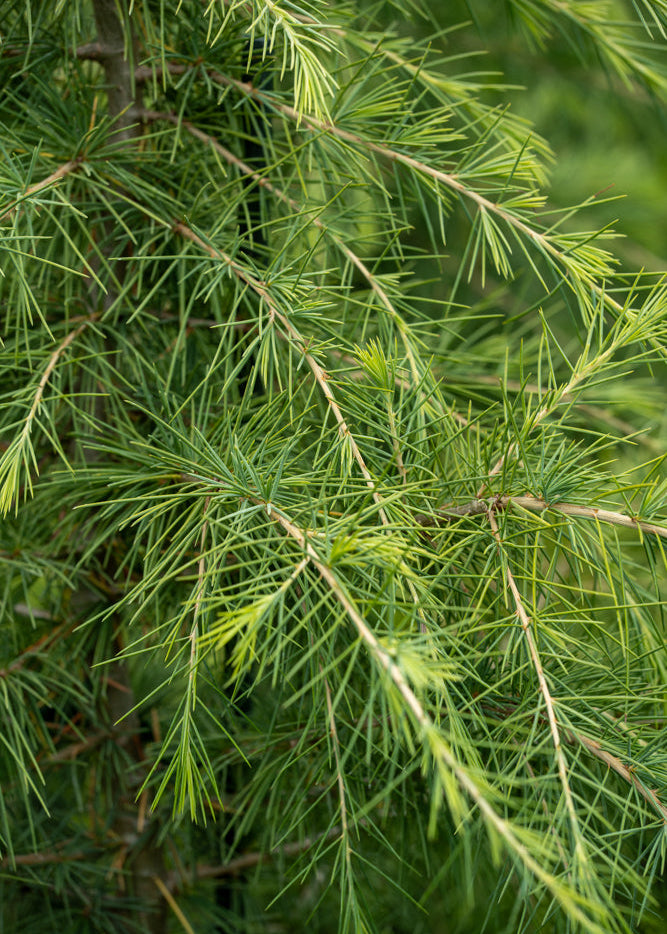
Cedrus Deodara
Cedrus Deodara
Himalayan Cedar
Cedrus deodara, commonly known as the Himalayan Cedar or Deodar Cedar, is a magnificent evergreen conifer known for its strong pyramidal form, softly textured blue-green foliage and distinctive gracefully drooping branch tips. Native to the Himalayas, it naturally develops into a substantial specimen tree with plenty of presence in the landscape.
This is definitely not a tree for squeezing into the spare metre beside the driveway. Given the room it deserves, however, Cedrus deodara makes an outstanding feature tree for large gardens, lifestyle blocks and park-like landscapes, providing permanent structure, shade and greenery throughout the year.
Why You'll Love Cedrus deodara
- Beautiful blue-green to grey-green evergreen foliage
- Graceful, pendulous branch tips
- Strong pyramidal shape
- Provides year-round colour and structure
- Excellent large feature or specimen tree
- Hardy in cold climates
- Impressive architectural form
- Develops into a magnificent long-term landscape tree
- Expected 5 Year Height 6.0 M Width 4.0 M
Is Cedrus Deodara suitable for my garden?
Is Cedrus Deodara suitable for my garden?
Cedrus Deodara is best suited in a position that gets
- Partial shade
- Full sun
Cedrus Deodara is
- Wind Tolerant
- Frost Tolerant
- Coastal Friendly
- Drought resistant
- Cold hardy
- Evergreen
Cedrus Deodara will thrive in soil that is
How to establish your Cedrus Deodara?
How to establish your Cedrus Deodara?
Plant Cedrus deodara in full sun.
When deciding where to put it, the most important consideration is space.
Choose a position:
Well away from buildings
Clear of overhead powerlines
With room for a broad canopy to develop
Where the tree can be viewed from a distance
With good soil drainage
Don't plant it somewhere based purely on the size it is today. This is a long-lived tree that can become very substantial.
How to maintain your Cedrus Deodara once established?
How to maintain your Cedrus Deodara once established?
Water deeply and regularly during the first couple of growing seasons.
Large conifers can lose considerable moisture through their evergreen foliage, so maintaining adequate soil moisture while the root system establishes is important.
Once established, Cedrus deodara develops good drought tolerance.
During prolonged Canterbury dry spells, occasional deep watering will still benefit younger trees and those growing in particularly dry soils.
Apply organic mulch around the root zone after planting to:
Retain soil moisture
Reduce competition from grass
Moderate soil temperatures
Improve the soil over time
Keep mulch away from direct contact with the trunk.
Feed young trees in spring with a balanced slow-release fertiliser if required.
Once established in reasonably fertile soil, Cedrus deodara generally requires very little supplementary feeding.
There's no need to force rapid growth – it is quite capable of becoming enormous without any encouragement from us.
Does Cedrus deodara Need Pruning?
Very little.
Its natural pyramidal shape and cascading branches are exactly what make this tree attractive, so routine clipping isn't required.
Prune only to:
Remove dead or damaged branches
Remove crossing growth where necessary
Correct structural problems while the tree is young
Maintain clearance where genuinely required
Avoid removing the central leader unless it has been damaged.
Hard or unnecessary pruning can ruin the natural form of the tree, so this is definitely one where it's better to choose the right planting position in the first place.
Cedrus deodara is highly cold tolerant, which isn't particularly surprising for a tree originating from the Himalayas.
It performs well in cooler New Zealand climates and is a good option for Canterbury gardens and lifestyle properties where frost is a regular winter occurrence.
Established trees generally require no special winter protection.
Once established, Himalayan Cedar is a robust tree, but young specimens benefit from protection from severe winds while their root systems develop.
Stake newly planted trees only where necessary and ensure ties aren't allowed to cut into the trunk as the tree grows.
For very exposed properties, getting a young tree properly established during its first few years will make a significant difference to its long-term performance.
Couldn't load pickup availability
Share