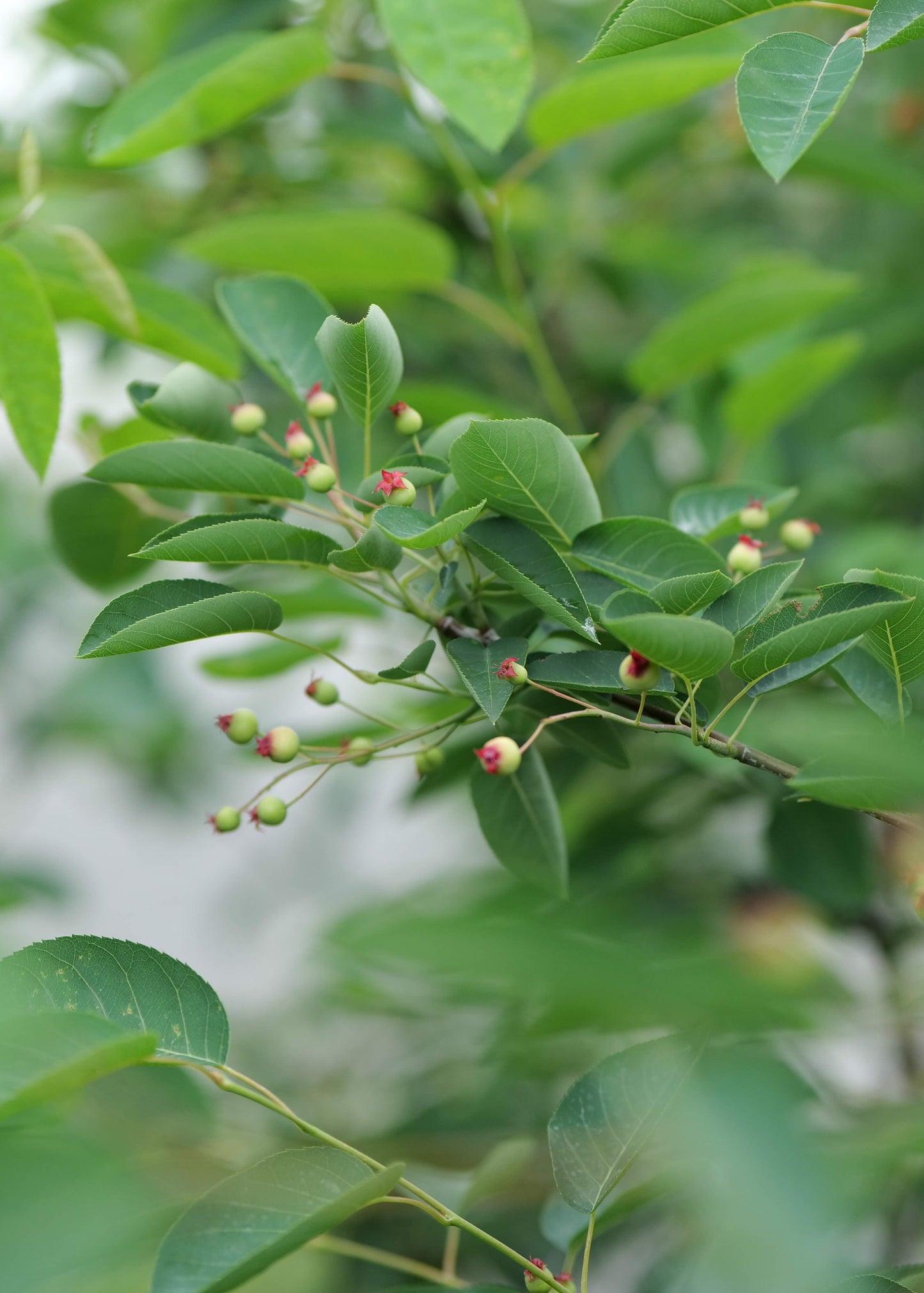
Amelanchier canadensis
Amelanchier canadensis
Shad Bush; Canadian serviceberry, Juneberry
Amelanchier canadensis, commonly known as Serviceberry, Juneberry or Shadbush, is a graceful deciduous small tree or large shrub that delivers interest across several seasons. In spring, its branches are covered with clusters of delicate white, star-shaped flowers, followed by small red-purple berries in summer and attractive yellow, orange and red autumn foliage.
With its naturally elegant branching habit and manageable size, Amelanchier is an excellent alternative to the usual ornamental flowering trees. It works beautifully as a feature tree, in mixed borders or woodland-style gardens and is particularly useful where you want something ornamental without eventually having an enormous tree on your hands.
The berries are also edible and attractive to birds – although you may find the birds have considerably faster harvesting skills than you do.
Why You'll Love Amelanchier canadensis
- Masses of delicate white spring flowers
- Attractive red-purple summer berries
- Berries are edible and popular with birds
- Beautiful yellow, orange and red autumn colour
- Graceful branching structure
- Excellent small feature tree
- Hardy and adaptable
- Provides interest across multiple seasons
- Great for wildlife-friendly gardens
- Expected 5 Year Height 3.0 M Width 2.0 M
Is Amelanchier canadensis suitable for my garden?
Is Amelanchier canadensis suitable for my garden?
Amelanchier canadensis is best suited in a position that gets
- Partial shade
- Full sun
Amelanchier canadensis is
- Wind Tolerant
- Frost Tolerant
- Coastal Friendly
- Drought resistant
- Flowering
- Attracts pollinators
- Cold hardy
Amelanchier canadensis will thrive in soil that is
- Swampy
- Clay
- Stoney
- Nutrient rich
- Free draining
How to establish your Amelanchier canadensis?
How to establish your Amelanchier canadensis?
Plant Amelanchier canadensis in full sun to part shade.
For the best flowering, fruit production and autumn colour, choose a position receiving plenty of sunlight.
It can also perform well in light or dappled shade, making it useful for woodland-style planting and areas around larger deciduous trees.
How to maintain your Amelanchier canadensis once established?
How to maintain your Amelanchier canadensis once established?
Water deeply and regularly during the first couple of growing seasons while the root system establishes.
Pay particular attention during the first summer, especially during extended dry Canterbury conditions.
Once established, Amelanchier is reasonably tolerant of short dry periods but will perform better with additional water during prolonged drought.
Consistent moisture is particularly useful during flowering and fruit development.
Apply organic mulch around the root zone each year to:
Conserve soil moisture
Reduce weed competition
Keep roots cooler
Gradually improve soil structure
Keep mulch clear of the trunk rather than piling it against the bark.
Apply compost or a balanced slow-release fertiliser in early spring if required.
Plants growing in good, fertile garden soil generally require very little additional feeding.
Avoid excessive nitrogen, which can encourage vigorous leafy growth at the expense of flowers.
Amelanchier requires relatively little pruning.
Its natural branching habit is one of its best features, so don't feel compelled to attack it with the secateurs every winter.
Prune to:
Remove dead or damaged branches
Remove crossing or rubbing growth
Thin congested areas if necessary
Maintain a single trunk or multi-stemmed form, depending on the look you want
Any significant shaping is best carried out while the tree is young.
Growing as a Tree or Large Shrub
Amelanchier can naturally develop multiple stems.
If you prefer a small tree, select a strong central leader and gradually remove unwanted lower growth as the plant develops.
If you prefer a more informal multi-stemmed woodland look, allow several main stems to develop.
Both forms can look fantastic – it really depends on where you're putting it.
Amelanchier canadensis is very frost hardy, making it an excellent choice for cooler New Zealand gardens.
Established trees require little special winter care. Newly planted trees benefit from a layer of mulch around the root zone.
As with many early spring-flowering plants, an unusually severe late frost can occasionally damage open flowers, but it won't generally harm the tree itself.
Flowers, Berries and Wildlife
The white spring flowers are valuable to pollinating insects, while the summer berries are extremely popular with birds.
The berries are edible for people too, with a sweet flavour when fully ripe. They can be eaten fresh or used in preserves and baking.
If you're determined to harvest them yourself, keep an eye on the fruit as it ripens – the local bird population probably already has.
Amelanchier is generally straightforward to grow, particularly when planted in an open position with reasonable airflow.
Maintain plant health by:
Removing dead or diseased material
Avoiding prolonged waterlogging
Maintaining good airflow through the canopy
Cleaning up fallen foliage where disease has been an issue
Keeping trees watered during prolonged drought
Couldn't load pickup availability
Share