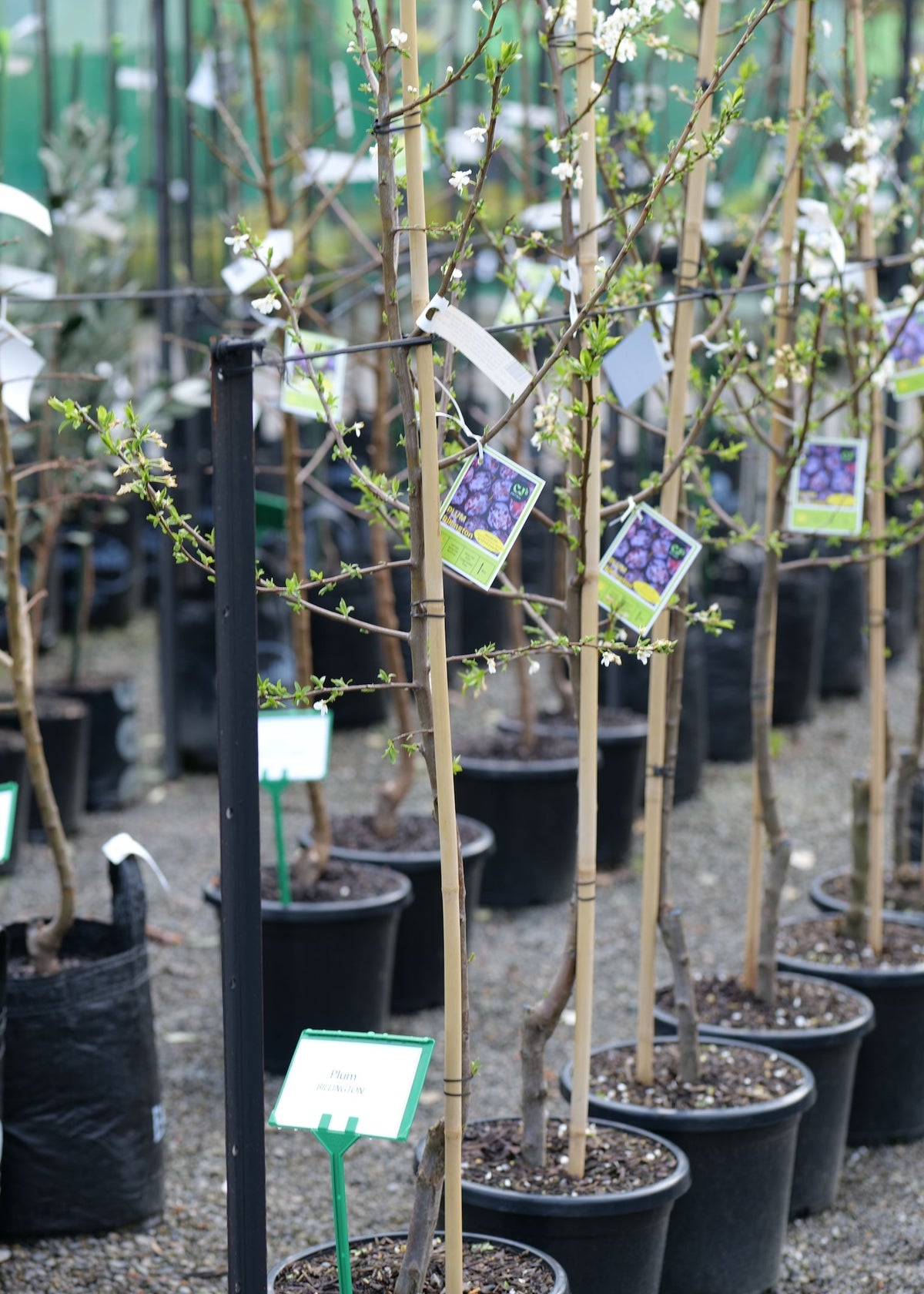
Plum ‘Billington’
Plum ‘Billington’
Plum 'Billington' is a fantastic early-season plum producing dark red to red-purple fruit with rich red flesh and a good sweet flavour. One of its biggest attractions is just how early it gets going – Billington is one of the first dark red plums to ripen, with crops often ready around Christmas in New Zealand.
It's also a particularly useful plum for the home garden because it can produce fruit without requiring another plum tree for pollination. However, planting a compatible variety such as Black Doris or Omega nearby can help improve the size and reliability of the crop.
Billington is a vigorous, productive deciduous fruit tree with pretty white spring blossom followed by generous summer crops. The fruit is a great all-rounder – good eaten fresh and equally useful for cooking, bottling and preserving.
Basically, if you're impatient for plum season to begin, Billington is a very good place to start.
Why You'll Love Plum 'Billington'
- One of the earliest dark red plums to ripen
- Crops around Christmas in many NZ conditions
- Dark red to red-purple skin
- Attractive red flesh
- Sweet, good-flavoured fruit
- Excellent all-purpose plum
- Heavy and reliable cropper
- Can produce fruit without a separate pollinator
- Excellent pollinator for several other plum varieties
- Beautiful white spring blossom
- Hardy deciduous fruit tree
- Great for home orchards and productive gardens
- Expected 5 Year Height 3.5 M Width 3.0 M
Is Plum ‘Billington’ suitable for my garden?
Is Plum ‘Billington’ suitable for my garden?
Plum ‘Billington’ is best suited in a position that gets
- Full sun
Plum ‘Billington’ is
- Self-fertile
- Wind Tolerant
- Frost Tolerant
- Edible
- Flowering
- Attracts pollinators
- Cold hardy
Plum ‘Billington’ will thrive in soil that is
- Free draining
- Nutrient rich
How to establish your Plum ‘Billington’?
How to establish your Plum ‘Billington’?
Plant Plum 'Billington' in full sun.
Plenty of sunlight encourages:
Strong flowering
Good fruit set
Fruit ripening
Better flavour and sweetness
Healthy growth
Choose a reasonably sheltered position with good airflow.
In Canterbury, some shelter from the strongest nor'west winds is beneficial, particularly while the tree is young and when it's carrying a heavy crop.
How to maintain your Plum ‘Billington’ once established?
How to maintain your Plum ‘Billington’ once established?
Water deeply and regularly during the first couple of growing seasons while the root system establishes.
A proper deep watering is considerably more useful than wandering past every evening and giving the soil surface a quick splash.
Once established, water during prolonged dry periods.
Consistent moisture becomes particularly important while the fruit is developing.
A heavily cropping plum tree is putting considerable energy and water into producing fruit, so don't allow it to become severely drought stressed at this stage.
Apply organic mulch around the root zone to:
Retain soil moisture
Suppress weeds
Protect roots from temperature extremes
Improve soil structure
Add organic matter
Keep mulch away from direct contact with the trunk.
This is particularly useful in Canterbury, where hot summer temperatures and nor'west winds can dry the upper soil surprisingly quickly.
Feed in spring with a balanced fertiliser suitable for fruit trees.
Compost or well-rotted organic matter can also be applied around the root zone.
If the tree is growing vigorously and producing well, don't go overboard with nitrogen.
Too much nitrogen can give you an impressive quantity of leaves and branches when what you actually wanted was plums.
Billington is known as a heavy cropper.
In particularly productive years, thinning some of the developing fruit can be beneficial.
Thinning helps:
Improve remaining fruit size
Reduce stress on branches
Reduce the risk of branches breaking under heavy crops
Improve airflow
Encourage more even ripening
It can feel slightly ridiculous deliberately removing perfectly good baby plums.
You'll understand why when the remaining ones get bigger.
Plums require slightly different pruning treatment from apples and pears.
Where possible, prune Plum 'Billington' during dry weather from spring through summer, particularly after harvest.
Avoid major pruning during cold, wet winter conditions, as this can increase the risk of diseases such as silver leaf.
Pruning should focus on:
Removing dead or damaged wood
Removing crossing branches
Maintaining an open framework
Improving airflow
Controlling overall tree size
Removing vigorous unwanted growth
Billington can become a substantial tree if left completely unpruned, so regular light management is much easier than attempting major surgery once it's enormous.
Keeping Your Plum Tree Manageable
Depending on its rootstock, Billington can eventually reach around 4–6 metres tall if allowed to grow freely.
For most home gardens, you don't necessarily need to let it.
Regular pruning can maintain a considerably more manageable tree, making:
Harvesting easier
Pruning easier
Pest monitoring easier
Bird netting easier
There's not much advantage in growing fantastic plums six metres in the air where only the birds can reach them.
Frost and Winter Care
Billington is a hardy deciduous fruit tree and handles cold winter conditions well while dormant.
Winter chilling is part of the natural seasonal cycle of deciduous fruit trees.
The more vulnerable period is spring flowering, when hard late frosts can damage open flowers and reduce the crop.
In colder gardens, avoid obvious frost pockets where cold air collects.
Protecting Fruit From Birds
Billington produces dark red fruit.
The birds will notice.
If you want a decent share of the crop, bird protection may become necessary as the fruit approaches ripeness.
Use securely fitted bird netting and ensure it remains taut so birds and other wildlife cannot become trapped.
Regular pruning that keeps the tree to a sensible size makes this considerably easier.
Good airflow and sensible pruning help reduce disease pressure.
Keep an eye out for common plum problems including:
Aphids
Scale insects
Caterpillars
Bacterial diseases
Silver leaf
Fungal problems during prolonged wet weather
Remove dead or diseased wood promptly and avoid unnecessary damage to branches and bark.
Good tree hygiene is considerably easier than trying to fix a badly neglected plum tree later.
Couldn't load pickup availability
Share