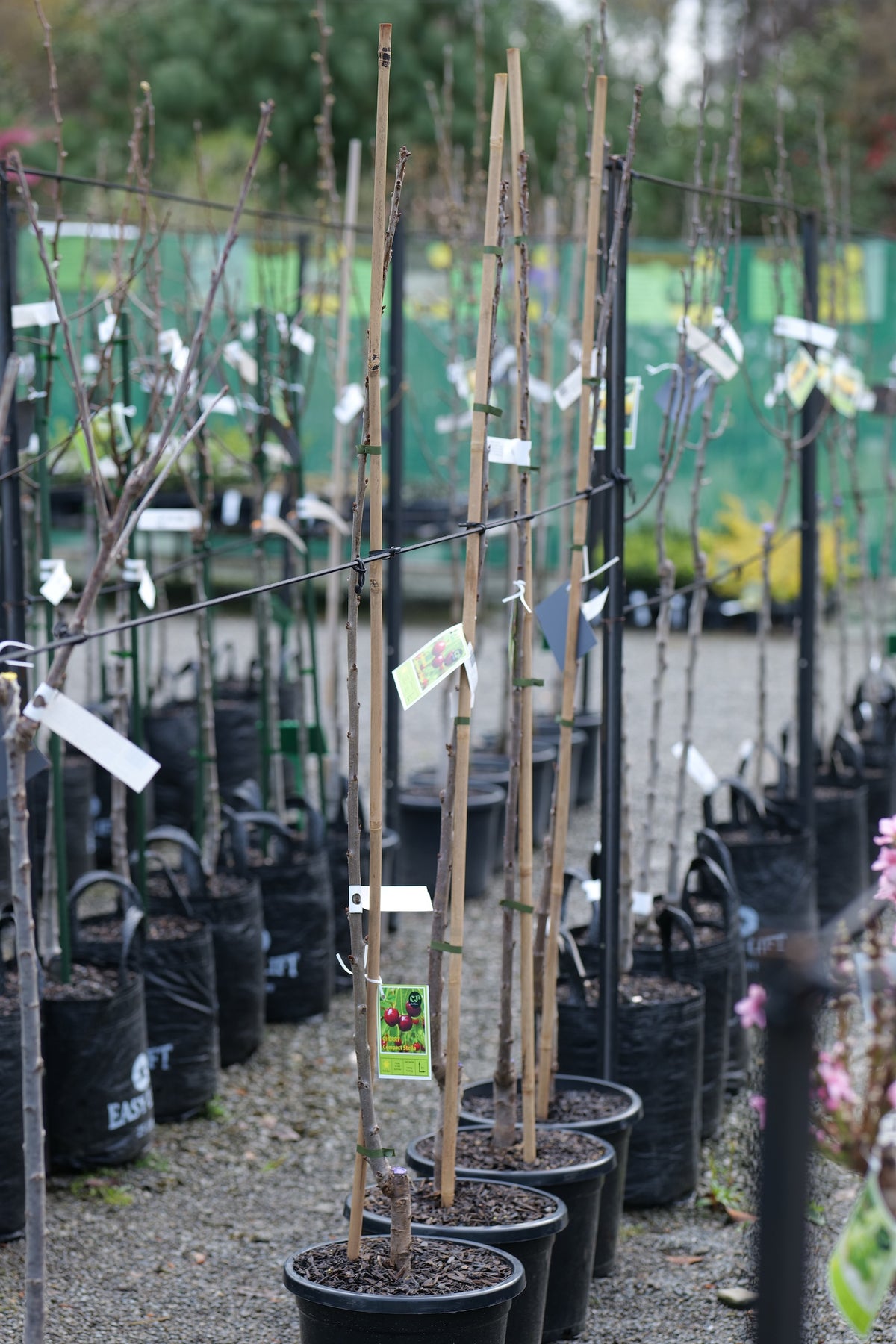
Cherry ‘Compact Stella’
Cherry ‘Compact Stella’
Love the idea of picking cherries from your own tree but don't have room for a small orchard? Cherry 'Compact Stella' is a more compact-growing form of the popular Stella cherry, producing large, sweet, dark red cherries on a tree that's much easier to accommodate in the average garden.
Even better, Compact Stella is self-fertile, meaning you can grow a single tree and still get fruit without needing another cherry purely for pollination.
In spring, the branches are covered in pretty white blossom, followed by developing fruit that ripens into delicious dark red cherries through summer. Hardy and deciduous, it's particularly well suited to cool, temperate New Zealand climates where it can get the winter chill it needs.
A proper fruit tree, just without quite so much tree.
Why You'll Love Cherry 'Compact Stella'
- Self-fertile – only one tree required
- Large, sweet cherries
- Attractive dark red fruit
- More compact than traditional large-growing cherry trees
- Beautiful white spring blossom
- Excellent fruit for eating fresh
- Hardy and cold tolerant
- Great for smaller residential gardens
- Easier to prune, harvest and bird-net
- Excellent addition to a home orchard or edible garden
- Expected 5 Year Height 2.0 M Width 2.0 M
Is Cherry ‘Compact Stella’ suitable for my garden?
Is Cherry ‘Compact Stella’ suitable for my garden?
Cherry ‘Compact Stella’ is best suited in a position that gets
- Full sun
Cherry ‘Compact Stella’ is
- Self-fertile
- Wind Tolerant
- Frost Tolerant
- Deciduous
- Edible
- Flowering
- Attracts pollinators
- Cold hardy
Cherry ‘Compact Stella’ will thrive in soil that is
- Free draining
- Nutrient rich
How to establish your Cherry ‘Compact Stella’?
How to establish your Cherry ‘Compact Stella’?
Plant Cherry 'Compact Stella' in full sun.
Good sunlight helps encourage:
Strong flowering
Good fruit set
Healthy fruit development
Even ripening
Sweeter fruit
Healthy tree growth
Aim for at least six hours of direct sunlight each day, with more being preferable.
A position with good airflow is beneficial, although some protection from Canterbury's strongest nor'west winds is useful.
How to maintain your Cherry ‘Compact Stella’ once established?
How to maintain your Cherry ‘Compact Stella’ once established?
Water deeply and regularly during the first couple of growing seasons while the tree establishes.
Deep watering encourages the root system to move further into the surrounding soil.
Once established, water during extended dry periods.
Consistent moisture is particularly important during:
Flowering
Fruit set
Fruit development
Hot summer weather
Avoid allowing the tree to become severely drought stressed while it's carrying fruit.
Apply a layer of organic mulch around the root zone to:
Retain soil moisture
Suppress weeds
Moderate soil temperature
Protect the root system
Gradually improve the soil
Keep mulch away from direct contact with the trunk.
Mulching is particularly helpful during Canterbury's hot, dry summers and nor'west conditions.
Feed in spring with a balanced fertiliser suitable for fruit trees.
Compost or well-rotted organic matter can also be applied around the root zone.
Avoid excessive nitrogen fertiliser.
Too much nitrogen can encourage vigorous leafy growth when what we're actually after is flowers and fruit.
Compact Stella should be pruned to maintain a balanced, open framework and manageable overall size.
Pruning should focus on:
Removing dead or damaged branches
Removing crossing growth
Improving airflow
Maintaining a strong branch structure
Controlling excessive height
Keeping fruit within reach
For cherries, significant pruning is best carried out during dry weather in summer or after harvest, rather than making large cuts during cold, wet winter conditions.
Regular light pruning is much easier on the tree than ignoring it for years and then deciding half of it needs to disappear.
Compact Stella is more compact than many traditional sweet cherry trees, but compact doesn't mean it stops growing at an exact height.
Final size will be influenced by:
Rootstock
Soil
Climate
Feeding
Water
Pruning
If you're growing it specifically because space is limited, maintain the tree with regular light pruning.
Keeping the canopy lower also makes harvesting and bird protection considerably easier.
There's little point successfully growing beautiful cherries four metres above your head.
Compact Stella is a cold-hardy deciduous fruit tree.
It loses its leaves in autumn and enters winter dormancy, with cool winter temperatures forming a normal part of its growing cycle.
Canterbury conditions generally suit this very well.
The more vulnerable period is spring flowering.
Hard late frosts can damage open blossom and reduce fruit set.
Where possible, avoid planting in the lowest part of a property where cold air naturally settles.
We should probably mention this before you learn the hard way.
Birds love cherries.
As the fruit begins colouring, consider protecting the tree with bird netting.
Compact Stella's smaller size makes netting considerably easier than it is on a large traditional cherry tree.
Any netting should be securely fitted and kept taut so birds and other wildlife can't become trapped or tangled.
Sweet cherries can occasionally split when heavy rainfall follows a dry period close to harvest.
The fruit rapidly absorbs moisture and the skin can crack.
Maintaining reasonably consistent soil moisture during fruit development can help reduce extreme fluctuations.
If the cherries are ripe and a significant period of summer rain is approaching, harvest promptly.
Good airflow, sensible pruning and general garden hygiene will help keep the tree healthy.
Keep an eye out for common fruit-tree problems such as:
Aphids
Scale insects
Caterpillars
Bacterial diseases
Fungal diseases during prolonged wet weather
Remove dead, damaged or diseased material promptly.
Depending on the rootstock, Compact Stella can also be considered for a very large container.
For container growing:
Choose a substantial pot
Ensure excellent drainage
Use quality growing media
Position in full sun
Water consistently
Feed during the growing season
Prune regularly to maintain size
Container-grown fruit trees require considerably more attention to watering than trees planted directly into the ground.
Couldn't load pickup availability
Share