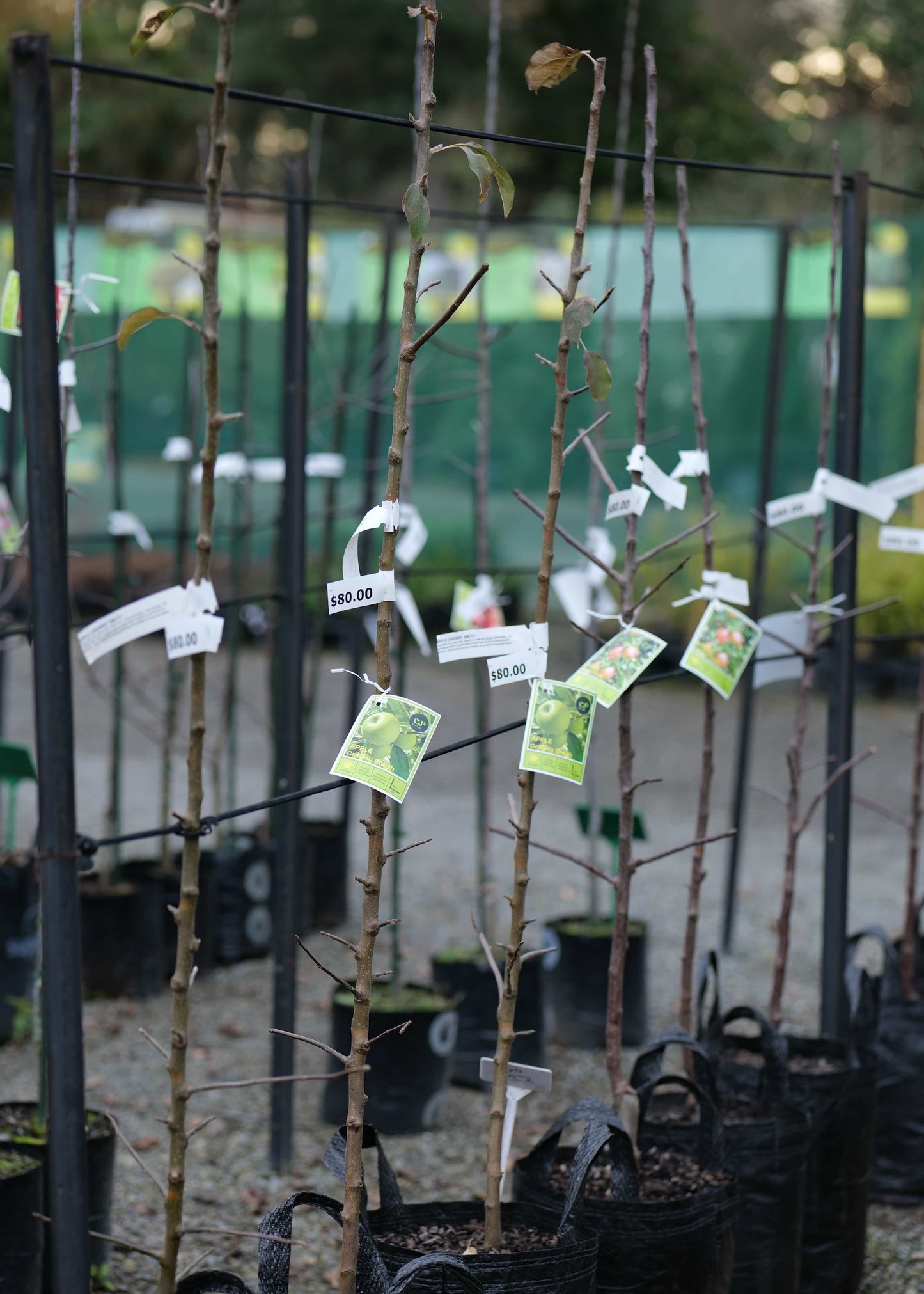
Apple Granny Smith
Apple Granny Smith
Granny Smith Apple
The Classic Crisp Green Apple – Tart, Juicy and Brilliant for Cooking
Apple 'Granny Smith' is one of the world's most recognisable apples, producing crisp, bright green fruit with a refreshing tart flavour. Excellent eaten fresh if you like your apples with a bit of bite, it's also one of the best cooking apples around, holding its shape and flavour beautifully in pies, crumbles, sauces and preserves.
Originally discovered in Australia in the 1860s, 'Granny Smith' has become a home-orchard classic for good reason. The tree produces attractive pink-tinged white blossom in spring, followed by green fruit that matures late in the season.
It's also a particularly useful variety to have in a mixed home orchard, as its late flowering period can make it a valuable pollination partner for other compatible apple varieties.
Why You'll Love Apple 'Granny Smith'
- Classic crisp green apples
- Refreshing tart flavour
- Excellent eating and cooking apple
- Fantastic for pies, crumbles and preserves
- Late-season harvest
- Excellent storage qualities
- Attractive spring blossom
- Hardy deciduous fruit tree
- Great addition to a mixed home orchard
- Expected 5 Year Height 4.0 M Width 3.0 M
Is Apple Granny Smith suitable for my garden?
Is Apple Granny Smith suitable for my garden?
Apple Granny Smith is best suited in a position that gets
- Full sun
- Partial shade
Apple Granny Smith is
- Edible
- Deciduous
- Fast-growing
- Cold hardy
- Attracts pollinators
Apple Granny Smith will thrive in soil that is
- Normal
- Free draining
- Nutrient rich
How to establish your Apple Granny Smith?
How to establish your Apple Granny Smith?
Plant Apple 'Granny Smith' in full sun.
For the best fruit production, choose a position that receives at least six to eight hours of direct sunlight during the growing season.
A good position should also have:
Reasonable airflow around the canopy
Protection from severe prevailing winds where possible
Plenty of room for the mature canopy
Free-draining soil
Good sunlight helps with fruit development, ripening and overall tree health.
How to maintain your Apple Granny Smith once established?
How to maintain your Apple Granny Smith once established?
Water deeply and regularly during the first couple of growing seasons.
Young fruit trees have relatively small root systems, so don't assume rainfall has done the job without checking the soil.
Once established, water during prolonged dry periods, particularly:
During flowering and fruit set
While fruit is developing
During hot summer weather
Consistent watering helps produce larger, juicier fruit and reduces stress on the tree.
Feed in late winter or early spring as growth begins.
Use:
Compost or well-rotted organic matter
A balanced fertiliser suitable for fruit trees
Avoid excessive nitrogen. A tree covered in enormous green leaves but hardly any apples isn't really the outcome we're aiming for.
Granny Smith benefits from cross-pollination with another compatible apple variety flowering at the same time.
Although it can produce some fruit on its own, planting a compatible apple nearby will generally improve fruit set and cropping.
When planning a home orchard, choose apple varieties with overlapping flowering periods rather than relying simply on having another apple somewhere nearby.
Bees and other pollinating insects do the actual work, so encouraging pollinators into the garden is also beneficial.
Prune apple trees during winter while they are dormant.
The aim is to create an open, well-balanced canopy that allows sunlight and air into the tree.
Prune to:
Remove dead or damaged branches
Remove crossing or rubbing growth
Thin congested branches
Remove strong vertical water shoots
Maintain the tree at a practical harvesting height
Once the basic framework is established, annual pruning is usually about maintaining rather than completely rebuilding the tree.
If your tree sets an enormous crop, thinning some of the young fruit can improve the size and quality of those left behind.
It also reduces the weight on branches and can help prevent the tree from exhausting itself with an oversized crop.
Thin crowded clusters once the natural early fruit drop has occurred.
In New Zealand, Granny Smith is a late-season apple, generally harvested around April to May, depending on your climate and growing conditions.
Fruit is ready when:
It has reached a good mature size
The skin has developed its characteristic bright green colour
The fruit comes away with a gentle lift and twist
Seeds inside are turning dark brown
Don't judge ripeness purely by sweetness – Granny Smith is meant to have that characteristic tart bite.
One of Granny Smith's biggest advantages is its excellent keeping ability.
For longer storage:
Select sound, undamaged fruit.
Handle apples carefully to avoid bruising.
Store somewhere cool and dark.
Keep fruit refrigerated if possible.
A well-grown crop can provide apples long after the tree itself has dropped its leaves for winter.
Granny Smith is frost hardy while dormant and is well suited to cooler New Zealand growing regions.
Winter chilling is beneficial for apple trees, but late spring frosts can damage open blossom and young developing fruit.
If your property regularly experiences severe late frosts, avoid planting in obvious frost hollows where cold air settles.
Keep an eye out for common apple problems such as:
Codling moth
Aphids
Woolly apple aphid
Apple scab
Powdery mildew
Good orchard hygiene goes a surprisingly long way.
Remove fallen or damaged fruit, prune to maintain airflow and clean up diseased material rather than leaving it beneath the tree.
Couldn't load pickup availability
Share